If you’re an MSP currently running ads on Google or LinkedIn, I’m going to tell you something that might sting: you’re burning cash. Seriously. Today, I’m revealing a secret strategy that no one is talking about, but it works exceptionally well. This approach will turn your paid advertising on its head and consistently generate leads. And I’m going to break down the entire process for you, step by step.
Let’s get started.
The big secret is this: if you’re an MSP today and you want to run ads, the best platform to do it on is Facebook and Instagram combined – that is, Meta.
Now, the biggest objection I hear in the MSP space is, “Scott, why would I run Facebook ads? I’m trying to attract business owners, decision-makers. They aren’t on Facebook, they aren’t on Instagram.”
Here’s the truth: the cost per lead on the Meta platform is significantly lower than it is on LinkedIn. I’ve run ads on LinkedIn for a number of years, and they are always consistently four, five, six times as much as they are on the Meta platform (Facebook and Instagram).
The Power of Meta’s Machine Learning & AI
The other thing Meta has going for it is its machine learning and AI on the ad platform – it’s far more advanced than it is on the LinkedIn platform. Sure, on LinkedIn you can target particular industries, particular job titles. That’s great, but you’re still going to be paying a huge amount of money for those leads and those clicks.
Whereas with Meta, it basically learns over time who’s most likely to click on your ad and convert. It has machine learning in the background that figures all of this out. It takes data from your website, the types of people that come to your website, the types of people that interact on your Facebook and Instagram pages, and it figures out similar types of people. It’s a huge data set that none of the other platforms are capable of delivering on.
Now, Google. I have less experience with Google, but I know for a fact from an MSP’s perspective, you’re paying anywhere between $150 to $200 per click for those search engine results, which is mind-blowing to me. There’s a much lower cost solution on the Meta platform that I’m going to show you here today.
That’s what I’m going to break down, show you where to get started with ads, and this is an advanced strategy that you can use with any budget to get started with Meta ads.
Proof: Real Results from Our Own Campaigns
Okay, so I’m going to back this up with proof. First of all, I’m going to show you the ad spend that we’re running at the moment for our own business, and I’m going to show you the type of leads that we’re getting with these ads. Once I’ve done that, I’m going to show you the structure of the ads, how to set up the ads for success.
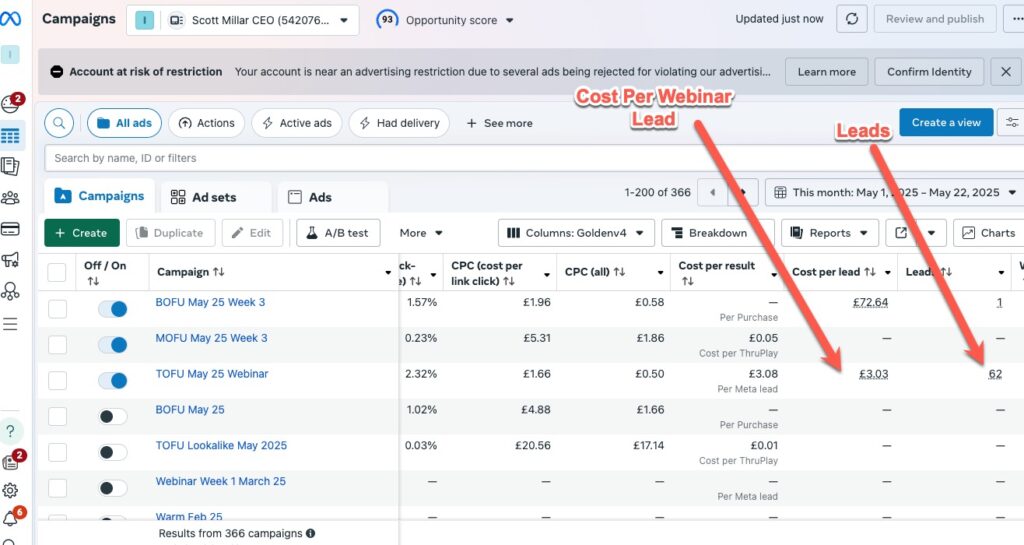
So, if we go into my Meta Business Manager here, you can see that I’ve got three types of ads running: TOFU, MOFU, and BOFU. I’ll go into exactly what that means a little bit later, but the one that we’re interested in here is this top one, this bottom one here, TOFU.
And if I scroll over here, you can see this is over the last probably six days I think these have been running. I’ve spent around about $150 US dollars, 128 pounds, and the ad has been seen by 1,863 people. That’s this reach column here. And the cost that I’m getting per lead is all the way over here. I’ve had 40 leads, and they’re costing me three pounds, 20, which is around about five bucks now.
Okay, that’s great, but how am I getting these leads and what am I going to do with these leads once I’ve got them? We’ll go into that.
This is the lead center that’s part of the Meta platform. So when you run a lead gen ad, I’m going to show you what that looks like. It’s basically a form that opens up in the Facebook or Instagram timeline, and you can capture details. If I click on some random person here, I will blur out some of the details, but you can see that’s the actual company here. And they’ve also given me their mobile number.
The TOFU, MOFU, BOFU Framework
The way that I have these set up is in this campaign here. So, TOFU stands for Top of Funnel, MOFU is Middle of Funnel, and BOFU is Bottom of Funnel. A little marketing education for you guys and girls here.
The types of ads that you want to run in these three separate campaigns:
- Top of Funnel (TOFU): You’re going to have lead gen ads, and you’re going to run these ads to something like a webinar. That’s what I do with my lead gen ads. I run them to a webinar, so when someone clicks on the ad, they register their details and they get sent an invite to a webinar. I love webinars because I can connect with the audience. I capture the lead details, I can nurture them in my CRM, and I can follow up with them. You can’t really build a relationship with a download, whereas a webinar, you can get a little bit of rapport and you can start to build the relationships. These are usually static images, and you’ll have, as I say, a form. The ad that I’ve got running at the moment is for my CoPilot webinar where I’m basically teaching MSPs how they can generate more revenue with Microsoft CoPilot. I use three images and two sets of ad copy. The machine learning behind this works out the best version of the copy and the best version of the image, and it does it all for me. I run this to a cold audience, so there’s absolutely no targeting at all. If you’re operating in a local marketplace, you would maybe set the top of funnel ads to that local marketplace, but that would be the only targeting you would do. As an MSP, I have no targeting; I let the machine basically figure out for me who to show the ad to and who’s most likely to click on the ad.
- Middle of Funnel (MOFU): This is where we kind of nurture people that have engaged with our ad, or they’ve engaged on our website, so they’ve maybe gone to our website or they’ve maybe clicked on one of our Facebook or Instagram pages or one of our posts. Now, it doesn’t necessarily have to be someone that’s seen one of your ads. This could be someone that’s visited your website within the last 30 days that will see this ad as well. We’ve cookied them with the Meta pixel, so we basically capture a larger segment of a warmer audience. So the top of the funnel is the cold audience, the middle of the funnel is the warmer audience, and I basically have video shorts as my middle of funnel. The way that I come up with video shorts is when I’ve done the webinar, I go into a tool like Opus Clip. I upload the webinar recording into Opus Clip, which has some AI behind it, and it basically generates short reels for me that I can use in my middle of funnel. These will be shown to the warm audience in their timeline over time, and they’ll maybe get shown once or twice a day. I do a webinar every couple of weeks, so I basically change up those middle of funnel shorts every week, every two weeks. I’ll change it up with fresh videos for that warm audience to consume, and it basically nurtures the audience that we’re building.
- Bottom of Funnel (BOFU): This, again, is targeted to the warm audience. And we have conversion-based ads. Meta allows you to create a type of ad set called a “sales” or a “lead” ad set. Because I run a membership, it’s more of a transactional type of transaction that I’m looking for, so I have a “sales” objective in the campaign. But you as the MSP, you’re probably going to go with a “lead” objective here. And the way that this runs for your perspective as an MSP is your conversion point is going to be booking a sales appointment in the diary – so booking a discovery call, a network assessment, a cybersecurity assessment, an AI maturity assessment – it’s going to be one of those sort of three things that you’re going to advertise. And the cool thing with these ads is that it doesn’t cost a lot.
Budgeting for Success
The way I have the budget split: I have about $30 a day on the top of funnel. It keeps my audience warm, and then I have about maybe $12 a day on the middle of funnel, another $12 on the bottom of the funnel ads. And that keeps the audience fresh, it keeps it warm, and it keeps me generating leads in my pipeline.
And because I’m capturing in the top of funnel, because I’m capturing the contact details into my CRM, I can then nurture them in my CRM. So I can send them content, I can send them a newsletter, I can send them tips, or in my case, I send them to my YouTube channel where I show them videos like this.
That is the whole marketing process that I’ve got here at IT Rockstars. It works really well and it is basically called, I call it, paid distribution. So it’s basically you’re paying a little bit of money to Meta to reach the people that you want to basically target with your ads. But you get to keep the contact.
With your sort of standard organic posting, like on social media, you’re going to be lucky if even your ideal prospect sees that post, because there’s just so much content out there. Whereas if you pay a little bit of money behind it, you’re going to find it’s going to drive a lot more engagement on your social media platforms.
So that’s the ad setup, that’s what it looks like. And we’ve got the top of funnel, middle of funnel, and then the bottom of funnel conversion ads, and the conversion ads, they’re literally just image-based ads.
If you’re wanting a hand managing your ads, check out the 7 day free trail.
I’ll catch you in the next post.